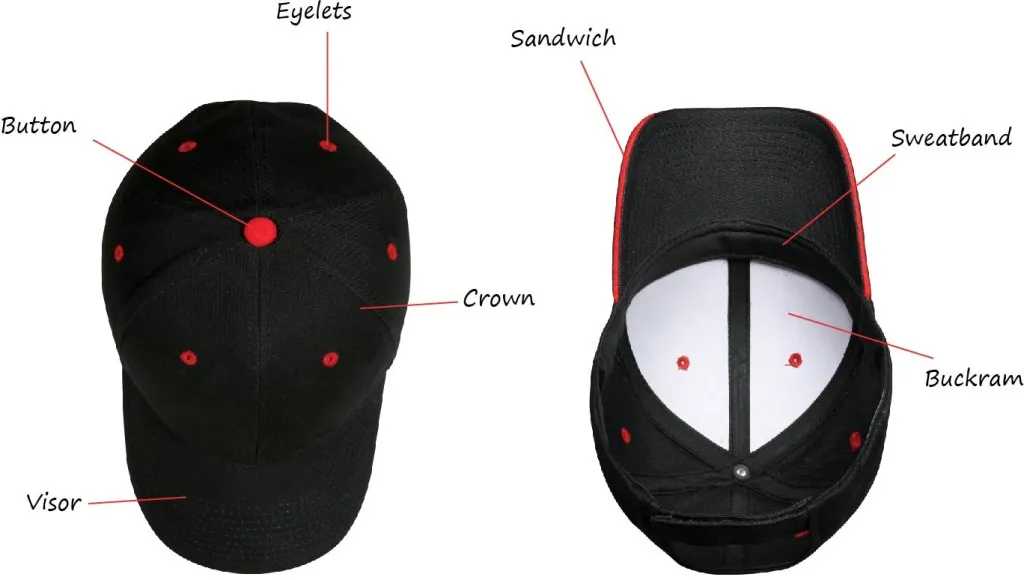
A great cap isn’t just a piece of fabric you throw on your head. It’s a carefully engineered accessory. Every stitch, panel, and button serves a purpose—whether that’s providing shade, offering all-day comfort, or simply making a bold style statement.
If you’re buying, customizing, or just curious about what makes a quality hat, understanding the anatomy of a cap will change the way you look at headwear forever.
Here is your complete breakdown of the parts that make a cap work.
The crown is the main body of the cap that sits on your head. It is constructed from individual fabric panels sewn together.
Panel Count: Typically 6 panels, though 5-panel designs are also popular for a lower, more relaxed profile.
Standard Panel Width: 75mm across.
The "Jewels" of the Crown
Four key components bring the crown together and define its feel:
Buckram (The Structure):
This is the stiff, woven fabric inserted into the front panels of the crown. It gives a "structured" cap its tall, rigid shape that stands out in a crowd. Prefer a relaxed, easy-going vibe? Go for an unstructured cap.
Without buckram (and often with a heavy wash), the crown is soft, low-profile, and molds to your head.
(Fun fact: Unstructured, low-profile caps are consistently the best-selling style across the headwear industry).
The Button:
The literal jewel on top of the crown. This fabric-covered metal or plastic disc (15mm diameter) holds all the panels together at the apex. It can match the cap or provide a sharp contrasting pop of color.
Eyelets:
These are the ventilation holes that keep your head from overheating. Most caps feature six embroidered or metal (8mm gunmetal) eyelets, one in each panel. If the cap has mesh back panels, eyelets are usually omitted, as the mesh handles the airflow.
The Sweatband:
The 30mm-wide fabric band lining the inside bottom of the crown. A quality sweatband does more than just absorb sweat; it wicks moisture away from your skin. Premium caps even feature cooling sweatbands that can reduce the fabric temperature by 5 degrees or more.
2. The Closure (Enclosure)
How the cap stays on your head is just as important as how it looks.
There are three main types of closures:
Fitted:
A closed-back cap sized precisely by inches. You need to know your exact head measurement for a perfect, seamless fit.
Stretch Fit:
Also closed-back, but woven with elastic materials in the fabric and sweatband. These comfortably adapt to a range of head sizes (typically grouped as S/M, M/L, or L/XL).
Adjustable:
The most popular and versatile option. It allows one cap to fit a wide variety of head sizes.
Adjustable closures come in a few premium variations:
Hook-and-loop tape (Velcro)
Plastic snap tabs (the classic "snapback")
Tuck straps with a metal slide or gunmetal clasp (often made from the same fabric as the cap for a clean, seamless look).
Standard back strap dimensions: 16mm wide x 145mm long.
3. The Peak (Visor or Brim)
While many people call it the "bill" or "brim," visor is the technical term.
It is a durable, flexible plastic compound attached to the front of the crown and wrapped in fabric.
Shape:
It can be flat, pre-curved, or slightly pre-curved to shield your eyes from the sun.
Length:
Typically extends about 70mm from the crown.
The "Sandwich":
This is a premium detail. A sandwich is an extra 3mm-thick layer of fabric (or a woven label) stitched between the top and bottom layers of the visor. It adds a subtle pop of contrasting color or branding, giving the cap a custom, high-end flavor.
Finishing Touches:
High-quality visors feature top-stitching (often 4 rows), bound edges, and an under-peak fabric that prevents sun glare from reflecting into your eyes.
4. Sizing & Build Specifications
Quality is in the details. A well-made cap features top-stitched seams throughout, covered inside seams for comfort (no itchy raw edges), and a crown that is professionally stitched directly to the peak for durability.
Standard Sizing:
Adult Standard: 58cm circumference
Kids: 54cm circumference
Stretch/Sized Fits: S/M (57cm) | L/XL (60cm)
5. Branding & Customization Dimensions
Whether you’re outfitting a team, promoting a brand, or creating a custom line, knowing the printable and embroiderable areas is crucial.
Embroidery Areas:
Front Cap Panel: 100mm x 53mm
Standard
Hat Panel: 80mm x 50mm
Visor: 80mm x 30mm
Screen Printing Areas:
5-Panel Cap: 80mm x 50mm
6-Panel Cap: 65mm x 55mm
Standard Hat: 100mm x 55mm
Visor: 80mm x 40mm
Note: Logos or lettering on the back of the cap (near the closure) can be applied in either a straight line or an arch, depending on the design.
A cap is more than just an accessory; it’s a combination of structure, material, and precise craftsmanship. From the hidden buckram that gives it shape, to the cooling sweatband that keeps you comfortable, to the sandwich visor that adds that final touch of custom flair—every detail matters.
Now that you know the anatomy of a cap, you’ll never look at (or buy) headwear the same way again. Choose the structure, closure, and details that match your style, and wear it with confidence.